Cryogenic air sampler
Serious MenThe Cryogenic air sampler is a remotely operated, sterilized steel device designed to collect air at a chosen altitude. In the balloon mission led by Arvind Acharya, samplers were sent to 41 kilometres above Earth, where the material recovered from one of them was reported to contain living cells. The instrument therefore stands at the hinge between a concrete laboratory result and a much larger, unsettled inference: that life may fall to Earth from space. It supplies evidence for the presence of organisms at extreme altitude, but the question of how they got there remains open.
Design and Mission
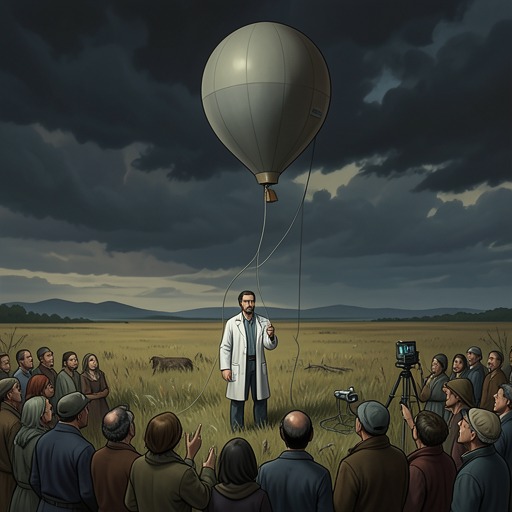
The sampler was part of a set of four carried by a hot-air balloon launched from the Institute of Theory and Research’s Hyderabad balloon launch site. The devices were sterilized steel units opened by remote control at a selected altitude, a procedure intended to collect air while limiting exposure to contamination. The mission’s target was 41 kilometres above Earth. Acharya’s stated reasoning was directional: if life existed at that height, it would more plausibly be coming down than travelling upward from the surface.
The four devices were distributed for analysis rather than examined together at the Institute. Two went to Cardiff, one to Boston, and the remaining sampler arrived at the Institute in a Toyota Innova. Oparna Goshmaulik’s research team and two American scientists, described as old friends of Acharya, worked on the Institute sample in isolation from the rest of the Institute. The narrative earlier notes that the cryogenic sampler was still stuck in America, underscoring how the apparatus and its movement were themselves part of the mission’s practical difficulties; it does not spell out the precise relationship between that delay and the later arrival of the Institute sampler.
Contamination and Control
The sampler’s importance depended on the claim that its contents had been protected from terrestrial material. Acharya had stressed that contamination could occur before or after a mission and used the difficulty of sterilizing a cryosampler completely to make a broader point: contamination was a serious problem in space exploration as well as in atmospheric sampling. He also observed that missions to the Moon and Mars had left Earth microbes behind. The instrument’s sterile construction and remote opening were thus not incidental engineering details; they formed part of the reasoning by which the team hoped to distinguish collected material from contamination introduced on the ground.
At the press conference, a reporter raised the possibility that the sampler had been contaminated in the laboratory. Acharya answered that precautions had been taken and that the organisms found were rare and difficult to culture in a laboratory environment. This response supported the team’s case but did not make the possibility of contamination disappear: the procedure was central precisely because the inference depended on excluding alternative routes by which the organisms might have entered the sample. The sampler consequently functions as both a container of evidence and a test of the reliability of the chain of handling around it.
Findings and Interpretation
After weeks of analysis, Oparna emerged from the basement laboratory with two American scientists and a bundle of handwritten pages tied with a cord. The report concluded that living cells had been found at 41 kilometres: spores of a rod-like bacillus and the fungus Engyodontium albus de Hoog. The finding was attributed to the sample recovered by the balloon mission and announced as a major breakthrough. When Acharya heard the result, he closed his eyes for so long that the visitors left without speaking; the physical sample had become the focus of a discovery whose implications exceeded the laboratory.
Acharya presented extraterrestrial origin as a reasonable guess supported by several facts, not as a conclusion. He pointed out that bacteria and fungi were not believed to exist at such heights and judged the possibility that space debris from defunct satellites had carried them there to be very small. He also explained that microbes in spore form could endure extreme conditions, perhaps remaining dormant for millions of years. These arguments made the sampler’s contents compatible with a space-origin hypothesis, but compatibility was not proof of origin. The device recovered organisms; the route by which they reached that altitude remained an interpretation.
Scientific and Narrative Significance
The sampler gives a material centre to a dispute over what counts as evidence and what claims science can responsibly make. In an earlier argument about the Giant Ear, Acharya rejected the search for alien signals as a narrow, publicity-seeking pursuit, while Jana Nambodri argued that even a very small mathematical possibility justified a search for truth. The balloon sample shifts that debate from distant signals to collected matter: a steel device, opened at a specified height, yields organisms that can be examined. Yet the result does not remove uncertainty. It relocates it to contamination controls, the organisms’ provenance, and the distinction between discovery and explanation.
That tension is sharpened by the Institute’s public announcement. The first report presented the finding as a stunning breakthrough, and Acharya later celebrated the possibility that humanity had been living with aliens. But the careful qualification at the press conference—that extraterrestrial origin was a reasonable guess rather than a conclusion—preserves the gap between the sample’s measurable contents and the cosmic history proposed for them. The Cryogenic air sampler is decisive not because it settles that history, but because it makes the question experimentally tangible while leaving the boundary between terrestrial and extraterrestrial life unresolved.